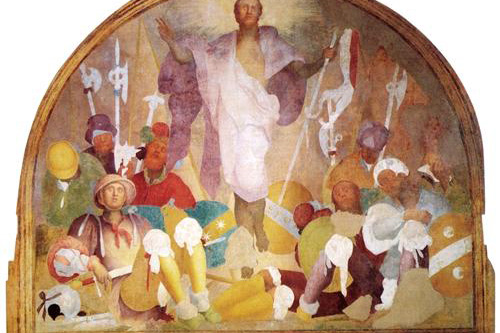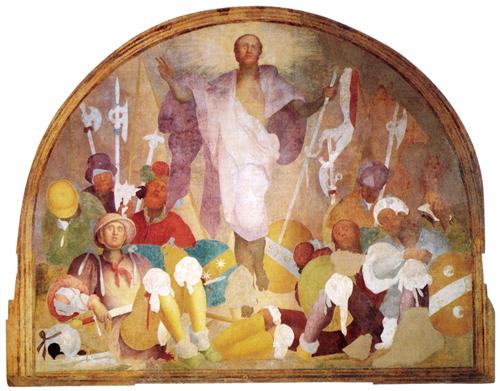
Where Is Jesus Between His Death and Resurrection?

040315Where is Christ after He dies on Friday afternoon and before He rises on Easter Sunday? Both Scripture and Tradition answer this question. Consider the following excerpt from a second century sermon as well as this meditation from the Catechism of the Catholic Church.

Ancient Homily for Holy Saturday (ca. 2nd century A.D.):

Today a great silence reigns on earth, a great silence and a great stillness. A great silence because the King is asleep. The earth trembled and is still because God has fallen asleep in the flesh and he has raised up all who have slept ever since the world began. … He has gone to search for Adam, our first father, as for a lost sheep. Greatly desiring to visit those who live in darkness and in the shadow of death, he has gone to free from sorrow Adam in his bonds and Eve, captive with him—He who is both their God and the son of Eve. … “I am your God, who for your sake have become your Son. … I order you, O sleeper, to awake. I did not create you to be a prisoner in hell. Rise from the dead, for I am the life of the dead.”

Nothing could be more beautiful than that line addressed to Adam and Eve: “I am your God, who for your sake have become your Son.”

St Ephrem the Deacon also attests to this descent among the dead and describes it rather colorfully:

Death could not devour our Lord unless he possessed a body, neither could hell swallow him up unless he bore our flesh; and so he came in search of a chariot in which to ride to the underworld. This chariot was the body which he received from the Virgin; in it he invaded death’s fortress, broke open its strongroom and scattered all its treasure. (Sermo de Domino nostro, 3-4. 9: Opera edit. Lamy, 1, 152-158. 166-168)

Scripture also testifies to Christ’s descent to the dead and what He did: For Christ also suffered once for sins, the righteous for the unrighteous, that he might bring us to God, being put to death in the flesh but made alive in the spirit, in which he went and proclaimed to the spirits in prison. … For this is why the gospel was preached even to those who are dead, that though judged in the flesh the way people are, they might live in the spirit the way God does (1 Peter 3:18; 1 Peter 4:6).

The Catechism of the Catholic Church on Christ’s descent to the dead (excerpts from CCC # 632-635):

[The] first meaning given in the apostolic preaching to Christ’s descent into hell [is] that Jesus, like all men, experienced death and in his soul joined the others in the realm of the dead.

But he descended there as Savior, proclaiming the Good News to the spirits imprisoned there [cf. 1 Pet 3:18-19]. Scripture calls the abode of the dead, to which the dead Christ went down, “hell”—Sheol in Hebrew, or Hades in Greek—because those who are there are deprived of the vision of God [cf. Phil 2:10; Acts 2:24; Rev 1:18; Eph 4:9; Pss 6:6; 88:11-13].

Such is the case for all the dead, whether evil or righteous, while they await the Redeemer [cf. Ps 89:49; 1 Sam 28:19; Ezek 32:17-32; Luke 16:22-26]. “It is precisely these holy souls, who awaited their Savior … whom Christ the Lord delivered when he descended into hell” [Roman Catechism I, 6, 3].

Jesus did not descend into hell to deliver the damned, nor to destroy the hell of damnation, but to free the just who had gone before him.

[So] the gospel was preached even to the dead. The descent into hell brings the Gospel message of salvation to complete fulfillment. This is the last phase of Jesus’ messianic mission, a phase which is condensed in time but vast in its real significance: the spread of Christ’s redemptive work to all men of all times and all places, for all who are saved have been made sharers in the redemption.

Christ went down into the depths of death so that “the dead will hear the voice of the Son of God, and those who hear will live” [1 Peter 4:6]. Jesus, “the Author of life”, by dying, destroyed “him who has the power of death, that is, the devil, and [delivered] all those who through fear of death were subject to lifelong bondage” [Heb 2:14-15; cf. Acts 3:15].

Henceforth the risen Christ holds “the keys of Death and Hades”, so that “at the name of Jesus every knee should bow, in heaven and on earth and under the earth” [Rev 1:18; Phil 2:10].

Here is a recording of a sermon I preached on this topic: Where is Jesus Now.

Finding the Good in Good Friday

"St.Martin-Karfreitag36" by Bene16 - eigens Werk. Licensed under CC BY-SA 3.0 via Wikimedia Commons.
“St.Martin-Karfreitag36” by Bene16 – eigens Werk. Licensed under CC BY-SA 3.0 via Wikimedia Commons.

When I was younger, and through my seminary years, I had usually seen the crucifix and Jesus’ suffering on the Cross in somber tones. It was my sin that put Him there, had made Him suffer. The Cross was something that compelled a silent reverence and suggested to me that I meditate deeply on what Jesus had to go through. I would also think of Mary, John, and the other women beneath the Cross mournfully beholding Jesus as He was slowly and painfully dying. These were heavy and somber notes but deeply moving themes.

In addition, the crucifix reminded me that I must carry my cross and go through the Fridays of my life. I needed to learn the meaning of sacrifice.

Liturgically, I also saw the crucifix as a way of restoring greater reverence in the Mass. Through the ’70s and ’80s, parishes had largely removed crucifixes, often replacing them with “resurrection crosses” or just an image of Jesus floating in mid-air. I used to call this image “touchdown Jesus” since He floated in front of the Cross with His arms up in the air as if signaling a touchdown. In those years we had moved away from the understanding of the Mass as a sacrifice and were more into “meal theology.” The removal of the crucifix from the sanctuary was a powerful indicator of this shift. Many priests and liturgists saw the Cross as too “somber” a theme for their vision of a new and more welcoming Church, upbeat and positive.

This “cross-less” Christianity tended to lead to what I thought was a rather silly, celebratory style of Mass in those years and I came to see the restoration of the crucifix as a necessary remedy to restore proper balance. I was delighted when, in the mid ’80s and later, the Vatican began insisting in new liturgical norms that a crucifix (not just a cross) be prominent in the sanctuary and visible to all, and further, that the processional Cross had to bear the image of Christ crucified (it could not just be a bare cross).

Balance Restored – I was (and still am) very happy about these new norms because they restore the proper balance in seeing the Mass as making present the once-for-all, perfect sacrifice of Jesus on the Cross. It is also a sacred meal, but it is the sacrifice that gives it its power. I also thought that such a move would help bring proper solemnity back to the Mass; to some extent this has been true.

All of this background is just to say that I saw the Cross, the crucifix, in somber, serious tones, a theme that was meant to instill solemnity and sobriety, a meditation on the awful reality of sin and our need to repent. And all of this is fine and true.

But the Lord wasn’t finished with me yet. He wanted me to see another understanding of the Cross. He wanted to balance my balance!

In effect, He also wanted me to experience the “good” in Good Friday. For while the Cross is everything described above, it is also a place of victory and love, of God’s faithfulness and our deliverance. There’s a lot to celebrate at the foot of the Cross.

It happened one Sunday in Lent of 1994, one of my first in an African-American Catholic parish. It being Lent, I expected the highly celebratory quality of Mass to be scaled back a bit. But, much to my surprise, the opening song began with an upbeat, toe-tapping gospel riff. At first I frowned. But then the choir began to sing:

Down at the cross where my Savior died,
Down where for cleansing from sin I cried,
There to my heart was the blood applied;
Glory to His name!

Ah, so this WAS a Lenten theme! But how unusual for me to hear the Cross being sung of so joyfully! (You can hear the song in the video below; try not to tap your toe too much.)

It was something quite new for me. Perhaps it shouldn’t have been but it was. The Catholicism of the ’70s and ’80s had found it necessary to remove the Cross to celebrate. But here was celebration with and in the Cross! Here was the good in Good Friday.

The Choir continued,

I am so wondrously saved from sin,
Jesus so sweetly abides within;
There at the cross where He took me in;
Glory to His name!

Congregation and choir were stepping in time and clapping, rejoicing in the Cross, seeing it in the resurrection light of its saving power and as a glorious reflection of God’s love for us. Up the aisle the procession wound and the last verse was transposed up a half-step in an even brighter key:

Oh, precious fountain that saves from sin,
I am so glad I have entered in;
There Jesus saves me and keeps me clean;
Glory to His name!

Yes, indeed, glory to His name! A lot of dots were connected for me that day. The Cross was indeed a place of great pain but also great love; there was grief but also glory; there was suffering but also victory.

Please do not misunderstand my point. There is a time and place for quiet, somber reflection at the foot of the Cross. All the things said above are true. But one of the glories of the human person is that we can have more than one feeling at a time. We can even have opposite feelings at almost the same moment!

The Balance – Some in the Church of the ’70s and ’80s rejected the Cross as too somber, too negative. They wanted to be more upbeat, less focused on sin. And so out went the Cross. There was no need to do this; it was unbalanced. For at the Cross the vertical, upward pillar of man’s pride and sin is transected by the horizontal, outstretched arms of God’s love. With strong hand and outstretched arms the Lord has won the victory for us: there at the cross where he took me in, glory to His name!

The balance is for the individual and for the Church. Some prefer a more somber meditation on the Cross to prevail while others feel moved by the Spirit to celebrate joyfully at the foot of the Cross. The Church needs both and I suppose we all need some of both experiences. Yes, it right to weep at the Cross, to behold the awful reality of sin, to remember Christ’s sacrifice. But we should rejoice, too, for the Lord has won victory for us right there: Down at the Cross. There’s a lot of good in Good Friday.

Here is the song I heard that Sunday in 1994, sung in very much the style I remember.

The Bread of Affliction: A Meditation on What Jesus Endured at the Last Supper

040115The Last Supper is, strangely, a sad study in the kind of affliction the Lord had to endure from His own disciples. Of all the meals the Lord must have shared with them, this was the one that should have gone beautifully and perfectly; it did not. From one moment to the next the blows just got worse. There were inept responses, distractions, bullheaded debates, and rebukes directed against Jesus … and then of course betrayal. It was nothing short of a disaster. The ineptitude would be almost comical if it weren’t so sad. If ever the Lord needed His disciples’ attention and understanding, it was at the Last Supper. But to a man, they let Him down. There was squabbling, misunderstanding, argumentativeness, and betrayal, all packed into one evening.

I am mindful that the unleavened bread Jesus took in His hands that evening was called “the bread of affliction.” Scripture says, You shall eat [the Passover]  with unleavened bread, the bread of affliction—for you came out of the land of Egypt in haste—that all the days of your life you may remember the day when you came out of the land of Egypt (Dt 16:3).

Indeed it was an evening of affliction! It was so awful that one could hardly have faulted the Lord for saying, “That’s it, Father. I’ve had it with them; I’m coming straight home!” Praise God that He chose to stay and die for the likes of us. And further, He takes this “bread of affliction” we dish out to Him and lifts it to the glory of the Sacrament of His Body and Blood.

Lest we be too critical of The Twelve, remember that we are often like them in many ways. Indeed, they are we and we are they. And the Lord loved both them and us to the end.

So on Holy Thursday, let’s examine the sequence of events at the Last Supper. It illustrates pretty well why the Lord had to die for us. We will see how earnest the Lord is about this Last Supper, how He enters it with an intense love for His disciples and a desire that they (we) heed what He is trying to teach them. We shall see, however, that they (we) show forth a disastrous inattentiveness and a terrible lack of concern for the Lord.

Here, then, are the movements of the Last Supper. Watch how things begin with the loving and careful attentiveness of the Lord and end with a selfish, inept, and unloving response from the Apostles (us?).

  1. COMING CLOUDS – Jesus knows that His hour has come; this will be His last meal. Judas has already conspired and been paid to hand Him over. Scripture says, Before the feast of Passover, Jesus knew that his hour had come. He always loved those who were his own, and now he would show them the depths of his love. The devil had already induced Judas, son of Simon the Iscariot, to hand him over (John 13:1). Thus in the gathering storm Jesus plans His last meal, which will also be the first Holy Mass. He instructs His Apostles to prepare the meal: He sent two of his disciples, and said to them, “Go into the city, and a man carrying a jar of water will meet you; follow him, and wherever he enters, say to the householder, ‘The Teacher says, Where is my guest room, where I am to eat the Passover with my disciples?’ And he will show you a large upper room furnished and ready; there prepare for us” (Mark 14:13-15).
  2. CARING CONCERN – This last supper was obviously important to Jesus. Luke records the heartfelt words of Jesus: And he said to them, “I have earnestly desired to eat this Passover with you before I suffer; for I tell you I shall not eat again until it is fulfilled in the kingdom of God” (Luke 22:15-16). Yes, this was to be a very special moment for Jesus.
  3. COSTLY COMMUNION – Jesus, reclining at the table, will now celebrate the Holy Eucharist for the first time. But this was to be a costly communion. He had already lost many disciples for what he taught on the Eucharist (cf John 6:50ff). After the first consecration, Jesus looks into the cup at His own blood, soon to be shed, and He distributes His own body, soon to be handed over. Yes, this is no mere ritual for Him. Every other priest before Jesus had offered a sacrifice distinct from himself (usually an animal, sometimes a libation). But Jesus the great High Priest will offer Himself; it is a costly communion.
  4. COLLABORATIVE CONDESCENSION – During the meal Jesus rises and then stoops to wash the disciples’ feet. He instructs them to see in this action a model for those who would collaborate with Him in any future ministry. John records it this way: He rose from the supper and took off his outer garments. He took a towel and tied it around his waist. Then he poured water into a basin, and began to wash the disciples’ feet, and to wipe them with the towel with which he was girded (John 13:5). Jesus then teaches the Disciples: Do you know what I have done for you? You call me Teacher and Lord; and you are right, for so I am. If I then, your Lord and Teacher, have washed your feet, you also ought to wash one another’s feet. For I have given you an example, that you also should do as I have done to you (John 13:12-15). Just moments from now, we will see them demonstrate a complete disregard for what Jesus has just tried to teach them. Now things get bad.
  5. CALLOUS CRIME– Back at table after having taught them that they must wash one another’s feet, Jesus suddenly becomes troubled in spirit and says, I tell you the truth, one of you is going to betray me (John 13:21). This causes a commotion among the Apostles, who begin to ask, “Who can it be?” As the anxiety around the table builds, Simon Peter motions to John and says, “Ask him which one he means.” Leaning back against Jesus, he [John] asked him, “Lord, who is it?” Jesus answered, “It is the one to whom I will give this piece of bread when I have dipped it in the dish.” Then, dipping the piece of bread, he gave it to Judas Iscariot, son of Simon. As soon as Judas took the bread, Satan entered into him. “What you are about to do, do quickly” Jesus told him (John 13:24-30).
  6. CONFOUNDING COMPETITION – But as Judas takes the morsel of bread and heads out into the night, no one even tries to stop him! Despite the fact that Jesus has clearly identified His betrayer, no one rises to block the door or even utters a word of protest! Why not? Luke supplies the answer: A dispute arose among them as to which of them was to be regarded as the greatest (Luke 22:24). They should be concerned about Jesus’ welfare but instead they debate which of them is the greatest. How confounding and awful! Yet is that not our history? Too often we are more concerned with our own status and welfare than with any suffering in the Body of Christ. So much that is critical remains unattended to because we are concerned with our own status, position, comfort, and welfare. Jesus had just finished teaching them to wash one another’s feet, but in an amazingly inept response, they end up arguing as to who among them is the greatest. Jesus patiently reminds them, The kings of the Gentiles exercise lordship over them; and those in authority over them are called benefactors. But not so with you; rather let the greatest among you become as the youngest, and the leader as one who serves. For which is the greater, one who sits at table, or one who serves? Is it not the one who sits at table? But I am among you as one who serves (Luke 22:25-27). Meanwhile, due to their (our) egotistical ineptitude Judas has escaped into the night.
  7. CAUSTIC CONTENTIOUSNESS – Jesus continues to teach at the Last Supper. At this moment He surely wanted to impress upon them His final instruction. How He must have longed for them to listen carefully and to deeply internalize what He was teaching! Instead, all He gets are arguments. Both Thomas and Phillip rebuke Him. John records this outrage: Jesus said, “Do not let your hearts be troubled. Trust in God ; trust also in me. In my Father’s house are many rooms; if it were not so, I would have told you. I am going there to prepare a place for you. And if I go and prepare a place for you, I will come back and take you to be with me that you also may be where I am. You know the way to the place where I am going.” But Thomas said to him, “Lord, we do not know where you are going; how can we know the way?” Jesus said to him, “I am the way, and the truth, and the life; no one comes to the Father, but by me. If you had known me, you would have known my Father also; henceforth you know him and have seen him. So Thomas rhetorically rebuked the Lord by saying, in effect, “We have NO IDEA where you are going; when will you show us the way?” Jesus answers, but Phillip will have none of this promise to see the Father and boldly says, “Lord, show us the Father, and then we shall be satisfied.” Jesus, likely saddened at all this, says to him, “Have I been with you so long, and yet you do not know me, Philip? He who has seen me has seen the Father; how can you say, ‘Show us the Father’? (John 14:1-9) His own Apostles are being argumentative and contentious. They are caustic and seem to rebuke the Lord. This supper isn’t going so well!
  8. COMIC CREDIBILITY GAP – Undeterred, Jesus embarks on a lengthy discourse (recorded by John) that has come to be called the priestly prayer of Jesus. At the end of it, the Apostles remark, perhaps ironically, perhaps with sincerity, Ah, now at last you are speaking plainly, not in any figure! Now we know that you know all things, and need none to question you; by this we believe that you came from God (John 16:29-30). But Jesus knows their praise is hollow and will not withstand the test. There is a great credibility gap in what they say, so much so that it is almost comical. So Jesus replies, Do you now believe? The hour is coming, indeed it has come, when you will be scattered, every man to his home, and will leave me alone (John 16:31-32). Peter protests, saying, Though they all fall away because of you, I will never fall away. Here is another almost comic credibility gap. Jesus says to Peter, Truly, I say to you, this very night, before the cock crows, you will deny me three times. Still insistent, Peter replies, “Even if I must die with you, I will not deny you.” And so said all the disciples (John 16:33-35). Well, you know the story, and you know that only John made it to the Cross. Their credibility was, by this time, a dark comedy.
  9. COMPASSIONATE CONSTANCY– But you also know the rest of the story. Jesus went on and died for the likes of them (us). I wonder if He had some of this Last Supper in mind when He said to the Father, “Forgive them, they know not what they do.” It is almost as if to say, “They have absolutely no idea what they are doing or thinking, so have mercy on them, Father.”

What a grim picture of us the Last Supper was! A disaster, really. But the glory of the story and the saving grace is this: the Lord Jesus Christ went to the Cross anyway. Seeing this terrible portrait of them (us), can we really doubt the Lord’s love for us?

May your Holy Thursday be blessed. I hope you will attend Mass and the Last Supper/First Mass will be made present to you. Never forget what Jesus endured!

Spy Wednesday and a Reflection on the Sins of the Clergy

033115Wednesday of Holy Week is traditionally called “Spy Wednesday,” since it was on this day that Judas conspired with the Temple leadership to hand Jesus over. He would not accomplish his task until the evening of the next day, but this day he made the arrangements and was paid.

One way to reflect on this terrible sin is to consider that Judas was among the first priests called by Jesus. We see in the call of the Apostles the establishment of the ministerial priesthood. Jesus called these men to lead His Church and minister in His name. But one of these priests went wrong, terribly wrong, and turned against the very one he should have proclaimed.

We also see great weaknesses among the other “first priests.” Peter denied Jesus, though he later repented. All the others except John deserted Jesus at the time of His Passion. Yes, I am sad to say, only one priest, one bishop made it to the foot of the Cross. All the rest fled in fear. And so here we see the “sins of the clergy” made manifest. Christ did not call perfect men. He promised to protect His Church from officially teaching error but this does not mean that there is no sin in the Church, nor that those who are called to lead are without sin. The story of Judas shows that even among those who were called, one went terribly wrong.

In recent years there has been much focus on the sins of Catholic priests who went terribly wrong and sexually abused the young. The vast majority of priests have never done such things, but those who did so inflicted great harm.

There are other sins of the clergy that have nothing to do with sexuality but that also may have caused great harm. Maybe it was an insensitive remark. Perhaps it was a failure to respond at a critical moment such as a hospital visit. And how many of you have lamented deeply the scandal of silent pulpits, the silence of so many clergy in the face of a moral meltdown? Whatever it might be that has harmed or alienated you, please don’t give up on God or on the Church. If a priest or a Church leader has caused you grief please know that there are other priests, deacons, and lay leaders who stand ready to hear your concerns and offer healing. Let the healing begin. Ask among your Catholic family and friends for recommendations about helpful and sensitive priests or Church leaders who can listen to your concerns, address them where possible, and offer another opportunity for the Church to reach out to you with love.

On this “Spy Wednesday” pray especially for priests. We carry the treasure of our priesthood in earthen vessels; as human beings we struggle with our own issues. We have many good days, but some less-than-stellar moments, too. The vast majority of priests, though sinners, are good men who strive to do their very best. But some among us have sinned greatly and, like Judas, caused harm to the Body of Christ. Some of us may have caused harm to you. Please accept this invitation to begin anew.

If you have stayed away because of some hurt caused by any leader of the Church, strive on this “Spy Wednesday” to still seek Christ where He is found. He is among sinners and saints, in the Church He founded. The Church is perfect in her beauty as the Bride of Christ, but consists of members who are still “on the way” to holiness.

After all my verbiage, here is a music video that presents this message better than I ever could. If you have ever known someone who has been hurt, or been hurt yourself, allow this powerful video to move you.

Mercy! So Great a Gift – Why Many Parishes Need to Reconsider When They Offer the Sacrament of Confession

"Исповедь берн собор" by Водник - Transferred from ru.wikipedia; (собственное фото). Licensed under CC BY-SA 3.0 via Wikimedia Commons.
“Исповедь берн собор” by Водник – Transferred from ru.wikipedia; (собственное фото). Licensed
under CC BY-SA 3.0 via Wikimedia Commons.

At tonight’s Chrism Mass, the Cardinal chose to focus his remarks to the more than 300 priests in attendance on the beauty of the Sacrament of Confession and the power of mercy. What a magnificent gift the Lord gave His Church through the ministry of priests, that we can hear His blessed words, I absolve you from your sins … go in peace.

My mind goes back to a beautiful story of St. John Paul II and a certain bishop (not of my own diocese). The story was told by the homilist at the funeral of this bishop over a decade ago and I was in attendance. Sadly, the bishop had a fall from grace and was forced to resign after an affair he had with a woman had come to light. Pope John Paul II accepted his resignation but within a month asked the bishop to come to Rome for a meeting. It was with some trepidation that the bishop made the journey. He was led into the meeting room by the usual Vatican staff, but, strangely, they all stepped out of the large, ornate room leaving him quite alone for a few minutes. The door opened and in walked Pope John Paul II, not with his usual entourage, but alone. The bishop was apprehensive, not knowing what to expect. He had let the Holy Father and God’s people down and a thousand nervous thoughts rushed through his mind. As he drew close, Pope John Paul II extended his large, muscular arms and put a hand on each shoulder of the bishop. He looked him in the eye and said, “Are you at peace?”

Relief and a profound sense of mercy flooded the bishop’s heart; his eyes often filled with tears as he recounted the story years later. None of us who heard it at the funeral failed to be moved either. The rest of the meeting with the Pope was never related by the bishop, who held that close to his heart, but he emerged reconciled and at peace. He spent his remaining years quietly ministering to several cloistered religious communities.

There is perhaps no greater gift than to experience the power and beauty of mercy. Yet it is a gift that is often wrapped in pain and in the humiliation of having experienced the true weight of our sins. It is no accident that the opening words of our Lord’s proclamation were “Repent and believe the good news” (Mk 1:15), specifically in that order. For unless we know the bad news, the good news is no news. To repent is to come to a new mind that, beholding God’s glory and holiness, sees the need for mercy. But oh, the glory then of the good news: mercy is available in abundance! God will never reject anyone who calls on Him (Jn 6:37). Oh, the relief, the peace of knowing the effect of those words spoken by God through His priests: “I absolve from your sins … go in peace.”

It is one of the greatest joys of a priest to confer that peace and to say those words, knowing that by his configuration to the Lord in the sacrament of Holy Orders, they are no mere wish; they in fact confer the absolution they announce and offer the only peace that really matters: the Lord’s peace. And as a priest I, too, need to hear those words addressed to me. I go to confession once a week and have no doubt at all that the progress and peace I experience are due to the power and beauty of those words: “I absolve you from your sins … go in peace.” I also give God thanks for the glorious Sacrament of Holy Communion, for His Holy Word in Scripture and Tradition, for the power of prayer, and for the honesty of fellowship with His Church.

In the past few years I became alarmed that the number of confessions was dropping. I added a number of reminders and exhortations to my preaching, but they had only a marginal effect.

Then I remembered an admonition by Fr. Dennis McManus, with whom I studied recently. He told us (most of whom were priests) that people would know we were serious about confession not by our words, but by our deeds. He went on to recite the pathetically limited schedule of confessions in a number of parishes with which he was familiar. In most cases it was barely an hour a week. And even then, it was not uncommon for the priest to show up late. Were there exceptions? Sure. And where exceptions did exist, confessions were numerous. The conclusion was clear: when priests are serious about offering confessions, the faithful are more serious about going.

I had thought I was already generous with offering confessions. I would enter “the box” half an hour before scheduled Masses. But, sadly, I spent a lot of time reading while waiting for penitents. We are not a downtown parish, so noontime confessions did not seem to be a good solution. My parish has a large commuter component due to our specialized liturgies, so many arrive just before Mass and sometimes even a bit late. Confessions just before Mass did not seem to be proving very helpful. I began asking what might work. People said, “Father could you hear confessions after Mass?” Sure.

Some liturgical purists might object, saying that people with serious sins need to go to confession before Mass. Agreed. So I continue to hear confessions before Mass. But now it was time to offer what people needed. After each Mass this Lent, I announced that I was headed to “the box” and that a Lent without confession was a disgrace.

The result? A bumper crop! I often heard more than a dozen confessions after each Mass. With four Masses, that was almost fifty confessions a weekend. And with five weeks of Lent, that was more than 200 confessions. Fr. Dennis was right.

Was I tired? Sure. But it was the right kind of tired. God is good, and many waited patiently in line after each Mass. When they knew I was serious, they were too. I am going to keep up this practice; it will not stop with Lent. After Mass, I make a few quick greetings and then it’s off to “the box.”

I am not here to tell you or any other priest what is right for your parish, but consider these key points. Mercy is a glorious gift and must be celebrated often. Repentance for the forgiveness of sins should be preached in every pulpit. And the same priest who exhorts repentance must be willing to be dedicated to the celebration of the good news of the mercy that comes with that repentance. It surely means expanded confessional times for most parishes, but those times will vary. Actually asking parishioners for suggestions may seem obvious, but what is obvious is not always what is done and “business as usual” tends to prevail.

Encourage your priests. Brother priests, encourage your people and ask what will work for them. When priests are serious, the faithful are too.

Mercy! No greater gift, for it restores us to Jesus. A costly gift? Often, yes. But it’s always worth it. Such precious words: “I absolve you of your sins … go in peace.”

Spend This Week With Jesus – A Daily Chronology of Jesus’ "Last" Week

032915At the heart of our faith is the Paschal mystery: the Passion, death, resurrection, and ascension of Jesus Christ. All of salvation history leads up to and goes forth from these saving events. The purpose of this post is to describe Jesus’ final week. We call this “Holy Week” because Jesus’ public ministry culminates with His suffering, death, and resurrection.

What follows is a brief description of each day of Holy Week. I hope you will print out this flyer (Walking-with-Jesus-In-Holy-Week) and read it each day this week. Prayerfully walk with Jesus in His most difficult yet most glorious week.

Some scholars of Scripture scoff at the idea that we can construct a day-by-day journal of Jesus’ last week. There are historical gaps and things in the different accounts that don’t add up perfectly. Further, St. John posits a slightly different timeframe (shifted by one day) for the Last Supper relative to Passover. The following sequence follows the timing of the synoptic (Matthew, Mark, and Luke) accounts. Despite certain scholarly doubts, the accounts really do add up pretty well if one uses a little imagination and sees the differences not as factual discrepancies but rather only as variations in the level of detail.

So read this chronology as a likely, but not certain, outline of the last week of Jesus. It is still a great blessing to consider the Lord’s last week and to walk with Him.

Plan to attend some or all of the special liturgies of Palm Sunday, Holy Thursday, Good Friday, and Holy Saturday at your parish. By celebrating them in community, we make them present today and we learn again, in a new way, the reality of our Risen Lord alive in our midst.

palm-sunday-2PALM SUNDAY – Our celebration of Holy Week begins today as we remember and make present the triumphal entrance of Jesus into Jerusalem to begin His final week and initiate His Passion. All four Gospels recount this triumphant entry that Sunday morning so long ago, but made present to us today. As you receive your palms, consider that you are part of that vast crowd. How will you journey with Jesus this week? Let the palms remind you to praise Him with your prayerful presence during the sacred Triduum. According to Mark 11:11, Jesus returned that evening to Bethany, a suburb of Jerusalem. Perhaps He stayed with his friends Martha, Mary, and Lazarus. Pray with Jesus this evening as He considers the difficult days ahead of Him.

Monday of Holy Week – According to Matthew 21, Mark 11, and Luke 19, Jesus returned to Jerusalem this day and, seeing shameful practices in the Temple area, cleansed it. John’s Gospel also records that Jesus rebuked the unbelief of the crowds. Mark 11:19 records that Jesus returned to Bethany that night. Pray with Jesus as He is zealous in His desire to purify us.

Tuesday of Holy Week – According to Matthew, Mark, and Luke, Jesus again returned to Jerusalem where He was confronted by the Temple leadership for what He had done the previous day; they questioned His authority. Jesus also taught extensively using parables and other forms. There was the parable of the vineyard (cf Mt 21:33-46), the parable of the wedding banquet (cf Mt. 22:1), the teaching on paying taxes (cf Mt 22:15), and the rebuke of the Sadducees who denied the resurrection (cf Mt. 22:23). There was also the fearful prophecy about the destruction of Jerusalem if the inhabitants did not come to faith in Him: Jesus warned that not one stone would be left on another (cf Mt 24). Continue to pray with Jesus and listen carefully to His final teachings just before His Passion.

Wednesday of Holy Week – Traditionally this day was called “Spy Wednesday,” for it was on this Wednesday before the crucifixion that Judas conspired to hand Jesus over. For this he was paid thirty pieces of silver (cf Mt. 26:14). Jesus likely spent the day in Bethany. In the evening, Mary of Bethany anointed Jesus with costly perfumed oil. Judas objected but Jesus rebuked him, saying that Mary had anointed Him for His burial (cf Mt 26:6). The wicked are besetting Jesus and plotting against Him; are you praying?

lastsupper1HOLY THURSDAY marks the beginning of the sacred Triduum, or “three days.” Earlier in the day, Jesus had given instructions to the disciples on how to prepare for this most holy meal, which would be His last supper. Throughout the day they made these preparations (cf Mt 26:17). In the Mass of the Lord’s Supper conducted at our parishes, we remember and make present that Last Supper which Jesus shared with His disciples. We are in the upper room with Jesus and the apostles and we do what they did. Through the ritual of washing the feet (Jn 13:1) of twelve parishioners, we unite in service to one another. Through our celebration of this First Mass and Holy Eucharist (Mt 26:26), we unite ourselves to Jesus and we receive His Body and Blood as if for the first time. At this Eucharist, we especially thank God for His gift of the ministerial priesthood. After the Last Supper (First Mass), Jesus and the apostles made a short journey across the Kidron Valley to the Garden, where He asked them to pray while He experienced His agony (cf Mt 26:30). We will process in Church with Jesus in the Blessed Sacrament to a garden (the altar of repose) that has been prepared. The liturgy ends in silence. It is an ancient custom to spend an hour before the reposed Blessed Sacrament this night. We are with Jesus in the Garden and we pray as He goes through His agony. Most of our parish churches remain open until close to midnight. It was nearly midnight when Jesus was betrayed by Judas, was arrested, and was taken to the house of the high priest (cf Mt. 26:47).

031809GOOD FRIDAY – All through the previous night, Jesus had been locked in the dungeon of the high priest’s house. Early in the morning He was brought before Pontius Pilate, who transferred the case to Herod. Herod promptly sent Him back to Pilate who, sometime in mid-morning, bowed to the pressure of the Temple leadership and the crowds and condemned Jesus to a horrible death by crucifixion. In the late morning, Jesus was taken by soldiers through the city and up the hillside of Golgotha. By noon He had been nailed to the Cross, where He hung in agony for some three hours. Jesus died at around three in the afternoon. He was taken down from the Cross and hastily placed in the tomb before sundown. Today is a day of prayer, fasting, and abstinence. To the extent possible, Christians are urged to keep today free of work, social engagements, and entertainment, devoting themselves to communal prayer and worship. At noon many parishes gather for Stations of the Cross and for recollections of the seven last words of Jesus. Many parishes also offer Stations of the Cross at 3:00 PM, the hour of Jesus’ death. In the evening, we gather quietly in our parish Churches to enter into a time of prayer, as we reflect on Jesus’ death on the Cross. We also pray for the needs of the world. To acknowledge the power of the Cross in our lives today, each of us in turn comes forward to venerate the Cross with a kiss. Our hunger from this day of fasting is satisfied with Holy Communion distributed at the end of this liturgy. Consider, too, how the apostles might have gathered that night together in fear and prayer, reflecting on all that had happened.

HOLY SATURDAY – The body of Jesus was in the tomb but His soul was among the dead, announcing the Kingdom. The hour is coming, and now is, when the dead will hear the voice of the Son of God, and those who hear it will Live (John 5:25). Consider what it must have been like for the dead in Sheol to awaken to the voice of Jesus! Meanwhile, the disciples, heartbroken at the death of Jesus, observed the Jewish Sabbath in sorrow. They had forgotten Jesus’ promise that He would rise. We cannot forget His promise. We cannot forget it. Tonight in our parishes, after sundown, we gather for the Great Easter Vigil, where we will experience Jesus’ rising from the dead. We gather in darkness and light the Easter fire, which reminds us that Jesus is light in the darkness. He is the light of the world. We enter into the church and listen attentively to Bible stories describing God’s saving work of the past. Suddenly, the church lights are lit and the Gloria is sung as we celebrate the moment of Christ’s resurrection. He lives! In the joy of the resurrection, we then celebrate the Sacraments of Baptism, Confirmation, and Eucharist for our catechumens and candidates, who have prepared for many weeks for this night. As a Church, we sing Alleluia for the first time in forty days. Do everything you can to be present on this evening, and invite friends and family to join you. Our Easter Vigil ushers in an Easter joy that never ends!

See What the End Shall Be – A Palm Sunday Reflection

032815The Passion, which we read in today’s liturgy, is too long to comment on in detail. I’ll examine just a portion of it in today’s blog.

The usual villains, such as the temple leaders, Judas, and the recruited crowd shouting “Crucify him!” are fairly obvious. They openly display their sinfulness and are unambiguously wicked. But there are other participants in the Passion accounts whose sinfulness, struggles, and neglect are more subtle yet still contribute significantly to the Lord’s sufferings on Good Friday. It is perhaps in these figures that we can learn a great deal about ourselves. For while we may not directly shout “Crucify!” we are often not as holy and heroic as the persecutors were wicked and bold.

In pointing out these behaviors, we must understand that we do these things. The Passion accounts do not merely describe people long since gone; they are portraits of you and me. We do these things.

Let’s look at the sins and weaknesses of Jesus’ followers (us) in three stages.

I. The Perception that is Partial – In today’s gospel, in the middle of the Last Supper Jesus’ disciples are reminded of what the next days will hold. Jesus says,

All of you will have your faith shaken, for it is written: I will strike the shepherd, and the sheep will be dispersed. But after I have been raised up, I shall go before you to Galilee.

Note that the apostles are being reminded of these facts, since Jesus has said them before on a few occasions. For example,

  1. From that time on Jesus began to explain to his disciples that he must go to Jerusalem and suffer many things at the hands of the elders, chief priests and teachers of the law, and that he must be killed and on the third day be raised to life (Matt 16:21).
  2. When they came together in Galilee, he said to them, “The Son of Man is going to be betrayed into the hands of men. They will kill him, and on the third day he will be raised to life.” And the disciples were filled with grief (Matt 17:22-23).
  3. We are going up to Jerusalem, and the Son of Man will be betrayed to the chief priests and the teachers of the law. They will condemn him to death and will turn him over to the Gentiles to be mocked and flogged and crucified. On the third day he will be raised to life!” (Matt 20:19)

Thus we see that the Lord has consistently tried to teach and prepare them for the difficulties ahead. He has told them exactly what is going to happen and how it will end: not in death but in rising to new life. But though he has told them over and over they still do not understand. Thus He predicts that their faith will be shaken.

Their perception is partial and they will see only the negative, forgetting that He has promised to rise. Because they cannot see beyond the apparent defeat of the moment, they will retreat into fear and will not accompany Him boldly and confidently to His passion and glorification (for His passion is His glorification). Instead they will flee. He has shown “what the end shall be,” but they cannot see or accept it. Thus fear overwhelms them and they draw back into sinful fear and dissociate themselves from Jesus. Only a few, His Mother Mary, John, Mary Magdalene, and a few other women would see Him through to the end.

But as for the rest, they see only what is gory and awful, missing what is glorious and awesome. Yes, their perception is partial and their blindness comes, paradoxically, from not hearing or listening to what Jesus has been telling them all along.

We, too, can easily suffer from such blindness caused by poor hearing. For the Lord has often told us that if we trust Him, our struggles will end in glory and new life. But, blind and forgetful, we give way to our fears and fail to walk the way of Christ’s Passion. We draw back and dissociate ourselves from Jesus, exhibiting some of the same tendencies we now recognize in the people of His day.

Let’s examine some of the problems that emerge from this partial perception and forgetful fear.

II. The Problems Presented – Several problems arise. They are unhealthy, sinful patterns stemming from the fear generated from not trusting Jesus’ vision and/or refusing to see it. Please understand that my use of the word “we” here is generic; I am not intending to imply that it applies to every single person. Rather, it means that collectively people have these tendencies. There is no need to take everything here personally.

A. DEFLECTING – When Mary of Bethany anoints Jesus with oil, some (led by Judas according to the other Gospels) claim that her extravagant care is offensive to the poor. This of course is a false dichotomy and Jesus calls them on it. It is good to care for the poor but it is also good to worship God. Judas is deflecting. Claiming to love the poor is likely a way to avoid looking at the fact that he does not really love Christ and that his heart is far from Him, so far in fact that he is preparing to betray Him. Care of the poor is good but it cannot be a substitute for a vigorous love of Christ and obedience to all He commands. Sadly, some reduce the gospel to what they call “social justice.” Too easily this can be a self-congratulatory deflection that hides the lack of wholehearted love and obedience that Christ seeks. In calling Judas on this He warns us as well. 

B. DISPOSED – When Jesus says to the disciples, “One of you will betray me,” each of them responds in turn, “Surely it is not I, Lord.” This is a moment of remarkable honesty. Though their replies express some incredulity, each knows deep down that he has the capacity to betray Christ … and so do we. We are predisposed in many ways to evil, betrayal, and sin. Our natures are fallen and we are easily selfish, even at the cost of grave injustice to others and betrayal of friends. We all have in us both great goodness and great inclination to evil. We must be sober and be willing to consider, “Surely it is not I, Lord.”

C. DOZING – One of the common human techniques for dealing with stress and the hardships of life is to just go numb, becoming drowsy. We can just doze off into a sort of moral sleep. Being vigilant against the threats posed to our souls by sin or the harm caused by injustice (whether to ourselves or others) is too stressful, so we just tune out. We stop noticing or really even caring about critically important matters. We anesthetize ourselves with things like creature comforts, meaningless distractions, alcohol, or drugs. In our moral slumber, we begin to lack a prayerful vigilance. Prayer and spirituality pose too many uncomfortable questions, so we just tune out and think about meaningless things like what a certain Hollywood star is doing or how our favorite sports team is faring.

In the Passion accounts, Peter, James, and John are asked by the Lord to pray with Him. But they doze off; perhaps it is the wine; surely it is the flesh (for the Lord speaks of it). But whether unwilling or unable to deal with the stress that the Lord is clearly under, they just tune out, go numb, and doze off.

Evil is at the very door, but they sleep on. The Lord warns them to stay awake lest they give way to temptation, but still they sleep.

Someone they know and love is in grave danger but it is too much for them to handle, so they just tune out, much as we tune out at the overwhelming suffering of Christ in the poor and needy. We stop noticing; it’s too painful so we just tune out.

The Lord had often warned them to be vigilant, sober, and alert (Mk 13:34, Matt 25:13, Mk 13:37; Matt 24:42; Luke 21:36, inter al). Other scriptures would later pick up this theme (Romans 13:11; 1 Peter 5:8; 1 Thess 5:6, inter al). For drowsiness is a significant and serious spiritual problem.

Sadly, God described us well when he remarked to Isaiah, Israel’s watchmen are blind, they all lack knowledge; they are all mute dogs, they cannot bark; they lie around and dream, they love to sleep (Is 56:10).

Despite the sleepiness of the disciples, the wicked are still wide awake and the threat does not go away by a drowsy inattentiveness to it. We need to be confident and sober. Life’s challenges are nothing to fear, for the Lord has told us we have already won if we trust in Him. The disciples have forgotten Jesus’ promise to rise after three days, and so, often, have we. So they, and we, give in to the stress and just tune out.

D. DISSOCIATING – Peter, confronted with the fearful prospect of being condemned with Jesus, denies being one of His followers or even knowing Him. He dissociates himself from Christ. We, too, when confronted with the prospect of far lesser things (like ridicule), will often deny a connection with the Lord or with the Church.

Someone might say about one of the more controversial passages of Scripture (such as prohibitions on divorce, fornication, and homosexual activity, or commands to tithe), “Oh, you don’t really believe that, do you?” And it’s too easy to give way to fear and either say no or to qualify our belief. Why suffer ridicule, endure further questioning, or experience the unpleasantry of debate?

So instead we just dissociate ourselves, compromising or qualifying our faith to avoid the stress. We even congratulate ourselves for being “tolerant” when we do it.

Jesus says, If anyone is ashamed of me and my words in this adulterous and sinful generation, the Son of Man will be ashamed of him when he comes in his Father’s glory with the holy angels (Mat 16:21). But too easily we are ashamed.

And so, like Peter, we engage in some form of denial. Peter was afraid because he forgot to “see what the end shall be.” He forgot that Jesus will rise after three days. So, too, do we often forget that. So we lack confidence and give way to fear. We deny so as to avoid suffering with Jesus.

E. DODGING – Simply put, when Jesus is arrested all the disciples except John disappear. They “get the heck out of Dodge.” They are nowhere to be found. One of them (could it be Mark himself?) even ran off naked.

After Jesus’ arrest, it is said that Peter (prior to his denials) had followed the Lord “at a distance” (Mk 14:54). But as soon as trouble arose, Peter scrammed as well.

And we, too, can run. Sometimes it’s persecutions from the world that cause us to flee. Other times it’s just our own self-generated fear that following the Lord is too hard; it involves too many sacrifices we are just not willing to make. Maybe it will endanger our money since the Lord insists that we tithe and be generous to the poor. Maybe it will endanger our playboy lifestyle since the Lord insists on chastity and respect. Maybe we are doing something we have no business doing, something that is unjust, excessive, sinful. But rather than face our fears, whether from within or without, we just hightail it out of town.

The disciples forgot that Jesus had shown them “what the end shall be.” In three days he would win the victory. But they forgot this, their fears emerged, and they ran. We, too, must see “what the end shall be” so that we can confront and resist our many fears.

F. DECEPTION – Pilate trots out a fake Jesus. His full name is “Jesus Barabbas.” Incredibly the name and title are the same, for “Barabbas” means “son of the father.” Pilate brings him out “Jesus, son of the father.” But Barabbas is a fake Jesus, a mere revolutionary who is popular with the crowd and they choose this deceiver, this revolutionary, this false messiah over their true savior. And this is case today. Many trot out a fake Jesus today who is reduced to a kind of harmless hippie. He makes no real demands except that we care for the poor and a few other bland ethical things like being nice. Gone is the summons to moral perfection in the Sermon on the Mount which includes less popular things like chastity, no divorce, commitment to the truth and taking up our cross. Yet many choose him and promote him out of concern that the real Jesus, the one described in Scripture, might not be palatable enough for the world today. And thus even historical Christian denominations have set many essential components of Jesus’ teaching and reduce everything to a kind saccharine “love” ethic and being “nice” and “inclusive.” Words like sin, judgment, hell and so forth used by the actual Jesus are go from the fake Jesus invented by those who fear that the real Jesus just won’t appeal today. But the fake Jesus cannot save, only the real one can.

G. DISAVOWAL – In this case our example is Pontius Pilate rather than one of the disciples. But the fact is that Pilate was summoned to faith just like anyone else. “Are you a king?” Pilate asks Jesus. Jesus responds by putting Pilate on trial, saying, “You say so.” In other words, you are the one saying these words; do you think they’re true?”

Pilate has a choice to make: accept what Jesus is saying as true or give way to fear and commit a terrible sin of injustice. The texts all make it clear that Pilate knew Jesus was innocent. But because he feared the reaction of the crowd, he handed Jesus over.

Note that it was  Pilate who did this. The crowds tempted him through fear, but Pilate did the condemning. Yet note that he tries to deflect his choice. Mark says that Pilate handed Jesus over to please the crowd, adding, he took water and washed his hands in front of the crowd. “I am innocent of this man’s blood,” he said. “It is your responsibility” (Mat 16:21). Actually, Pilate, it is also your responsibility. You had a choice and you made it. Your own career and your own hide were more important to you than justice. And though you wanted to do what was right and were sympathetic to Jesus, merely wanting to do what is right is not enough.

So, too, for us. We also often favor our career or hide over what is right. And in so doing we often try to blame others for what we freely chose: “I’m not responsible because my mother dropped me on my head when I was two” or other  such blame-shifting excuses.

We are often willing to say, in effect, “Look, Jesus, I love you. You get my Sundays and my tithe and generally I obey you, but you have to understand that I have a career; I need to make money for my family. If I really stand up for what is right I might not make it in this world. You understand, don’t you? … I know the company is doing some things that are unjust; I know the world needs a clearer witness from me and I’ll do all that … after I retire. But for now, well, you know. It’s really my boss who’s to blame. It’s this old hell-bound, sin-soaked world that’s to blame, not me.” And we try to wash our hands in an attempt to excuse our silence and inaction in the face of injustice and sin.

And all this is done out of fear. We forget “what the end shall be” and instead focus on the fearful present. We lack the vision Jesus is trying to give us: in three days we will rise with Him. But we remain blind to that and only see the threat of now.

III. The Path that is Prescribed – By now you ought to know the path that is prescribed: See what the end shall be! In three days we rise, so why are we afraid? Jesus has already won the victory. It is true that we get there through the Cross, but never forget what the end shall be! Today we read the gospel of Friday but wait till Sunday morning; I’ll rise!

We end where we began with this gospel: All of you will have your faith shaken, for it is written: I will strike the shepherd, and the sheep will be dispersed. But after I have been raised up, I shall go before you to Galilee.

Yes, after He has been raised, He goes before us into Galilee. And for us, Galilee is Heaven. Whatever our sorrows, if we are faithful we will see Jesus in the Galilee of Heaven. Never forget this vision. After three days we will rise with Him and be reunited in Galilee.

So take courage; see what the end shall be! For those who are faithful the end is total victory. We don’t need to doze, deflect, deny, dodge, or deflect. We’ve already won; all we need to do is hold out.

An old Gospel songs says, “I promised the Lord that I would hold out! He said he’s meet me in Galilee! So hold out, Galilee is not far, in three days we rise with him.”

Image credit above: The Ikon Studio

Why Wasn't the Resurrection More Like This?

I have often jested that Heaven has a poor marketing department. Jesus’ saving actions were “publicity poor” and many of the most important events, like His birth and Resurrection, were almost completely hidden. If I were God (and aren’t you glad I’m not!) I would ride down on a lightning bolt while the whole world marveled. And when I rose from the dead, I’d have put up the ancient equivalent of a Jumbotron so that everyone could watch as I gloriously stepped forth and sent word out to round up my enemies. At the very least I would have said “Ta Da!”

Somehow I thought of all that as I watched the commercial below. Imagine that the ad is focused not on a soccer match but on the tomb as the stone rolls back, light pours out, and Jesus emerges. Instead of the announcer yelling “Goal!” he could yell “Alive!” or “Like a Boss!”

Enjoy the commercial.

(I have written more seriously on the hidden quality of the resurrection here: Why was the Resurrection such a hidden event?.)